Wednesday, November 22, 2006

Snakes on a plane

Manila airport officials prevented a real life version of horror flick "Snakes on a Plane" this week when they stopped more than 130 reptiles, including poisonous cobras, from boarding a flight to Bangkok.

Dozens of lizards, wearing diapers to conceal the stench of their urine, and 60 snakes concealed in water bottles, were discovered on Tuesday morning inside two suitcases belonging to a Filipino woman, airport officials said.

Security officers noticed something moving when her luggage was being x-rayed. One of the nappy-clad lizards reportedly died due to heat.

Believed to be effective aphrodisiacs and good-luck charms, reptiles, amphibians and other exotic animals have become a popular delicacy and ornament in many parts of Asia.

Last week, Manila airport authorities arrested a Filipino man trying to smuggle three live Siamese crocodiles from Cambodia.

Pre-Inca tombs discovered

Archaeologists working in northern Peru have discovered a spectacular tomb complex about 1,000 years old. The complex contains at least 20 tombs, and dates from the pre-Inca Sican era.

Among the discoveries are 12 "tumis", ceremonial knives which scientists have not been able to study in a burial site before, as well as ceramics and masks.

The Sican culture flourished from approximately AD 800-1300, one of several metalworking societies which succumbed to drought and conquest. Archaeologists working on the project say the find will help them understand details of the culture.

Buried in a pyramid 30m (100ft) long, archaeologists found the bones of a woman in her early 20s surrounded by figurines of Sican gods, ceramics and objects in copper and gold.

Another set of bones, clearly from a person of some stature, were found in a seated position accompanied by a metallic crown, part of a thorny oyster, and various ceramic objects including a vase.

The tumis are a prize find, because until now the knives have come to scientists from tomb raiders. Finding them in situ would allow a closer understanding of their role in Sican culture, researchers said.

One of the tumis features a representation of Naylamp, the mythical founder of Sican society who according to legend emerged from the sea and became a god. The Sican were noted for producing gold, silver and copper in quantities which were substantial for the period.

They traded shells and stones with societies in what are now Ecuador, Chile and Colombia.

Their civilisation had already declined by the time that the mightiest of Peruvian cultures, the Inca, rose to prominence about AD 1200.

Tuesday, November 21, 2006

Be Nice: It's Now The Law

Calgary, Alberta, has new regulations that ban public fighting, spitting, defecation and urination. Loitering or putting your feet up on public benches are no-nos, too.

Officials said they're tired of the disgusting and disrespectful behavior. Violators can be fined, under an ordinance passed Monday.

But critics charge the anti-rudeness regulations are aimed at the homeless in city parks.

The city council narrowly passed the legislation.

Laurie Fuhr of the Calgary Housing Action Initiative said she and her group tried to quash the bylaw and they plan to continue fighting it, reported The Calgary Sun.

"There's parts of the bylaw ... that are really discriminatory to a certain group," she told the paper. "It effectively makes it illegal to panhandle or even to huddle or sleep outside."

Get your own back

Get cut off by some idiot on the freeway?

Now you can avoid doing something stupid on the road in retaliation and still get a little bit even.

Two Washington, D.C.-area men have created a Web site that allows people to post the license plate numbers of bad drivers.

Mark Buckman, a northern Virginia computer consultant, told The Washington Post he's outraged by careless, rude or inattentive drivers. He's co-founder of platewire.com. Buckman said they have hundreds of messages from drivers venting over the idiots they encounter on the roads.

The messages have headings like "Maniac" and "Jerk on the Phone."

The site says it is not just for complaining. On the site's introduction it says, "Report and flag bad drivers, award good drivers, and even flirt with cute drivers."

Here's an example from the site of one driver's warning:

Title
Agressive/confrontational

Wire type: Hazard
Make: FORD
Model: Crown Victoria
Color: white (old cop car)
Location: Ocean Springs, Mississippi
Description: At a 3 way stop and blinded by the sun, I accitdently turned left on "his turn". He had an old cop car spot light and shined it into my car. It was so bad I could not see the road ahead and had to pull over. This jerk then pulled up behind me (putting his car in the ditch...hehehehehe)and proceeded to yell and holler. Needless to say I left the area and called the police. They pulled him over an lectured him to calm down. Personally I would have gladly paid a ticket for failure to yield if they had hauled this turkey off to jail for something...anything!

Cunning stunt

David Blaine's latest stunt is as much about charity as publicity.

The magician travelled to Times Square on Tuesday for a topsy-turvy Thanksgiving escape, stepping inside a gyroscope where his hands and feet will be shackled. Blaine has until Friday morning to shed the shackles in the spinning scope; if he does, 100 children selected by the Salvation Army charity will go on a shopping spree.

The shackles go on Thursday at 2 p.m. ET, giving Blaine 16 hours to escape.

"This is more difficult than anything I've ever done," Blaine said before he was loaded into the gyroscope, which was then hoisted 12 metres into the air.

The gyroscope, with three spinning steel rings, will flip Blaine in various directions as often as eight times per minute.

Blaine has no protection from the weather other than his clothing - including a black nylon ski jacket with matching pants.

Tip-sy Weightlifter

New Zealand - A national title-winning weightlifter misguidedly used his talents to tip over a parked car, causing nearly NZ$1800 damage.

Jonathon Selkirk, 22, who is a national title winner in the under-85kg class for weightlifting, admitted a charge of wilful damage.

The Christchurch District Court was told yesterday that while visiting Invercargill for a weightlifting contest on October 15, Selkirk, who was intoxicated along with three associates, helped pick a parked car and tip it on its side.

Panel damage was caused along one side and a window was smashed in the early-morning offence, reparation of $1704 being sought. Only Selkirk and one other man were caught, the other receiving police diversion.

Judge David Holderness said his actions showed "very poor judgment. In future you had better keep your weightlifting activities to organised competition," he said.

Lawyer Simon Shamy said Selkirk was willing to pay all the reparation. He was studying for an engineering career, and a conviction could affect career prospects.
Selkirk was of otherwise good character and had prospects of national representation overseas in his sport.

The judge agreed to discharge Selkirk without conviction, but ordered $1704 reparation and $250 costs.

He said if the others involved had any decency they would reimburse Selkirk for their share of reparation.

Mustard or rat poison ?

An Ocean County woman who police say tried to poison her live-in sister and her sister's boyfriend by putting rat poison in their sandwiches has been charged with two counts of attempted murder.

Dana Simons, 43, was arrested Friday after her sister called police to report finding rat poison pellets in the couple's sandwiches on two separate occasions.

The sister, 51, and boyfriend, 50, did not eat the sandwiches and were unharmed.

The first time Simons' sister noticed something odd was earlier in the week, when Simons brought home sandwiches for the couple that appeared to have a blue-green pellets mixed in with the chicken.

The couple thought it was strange and threw out the food without eating any.

Authorities said when Simons came home again the next day with sandwiches for the couple, they figured out what the pellets were made of.

"They saw the blue-green pellets again and made the connection to the container of rat poison they found in the house," Ocean County Assistant Prosecutor Martin Anton told the Asbury Park Press for Sunday newspapers.

Simons, who until recently worked at a nearby deli, faces five to 10 years in prison for each attempted murder charge if convicted. She was released on her own recognizance.

Oldest college graduate

Like most students at Fort Hays State University, Nola Ochs plans to spend some time reading and studying during this week's fall break. But she'll take time out on Wednesday to celebrate her 95th birthday.

Ochs is living at Wooster Hall on campus while pursuing her general studies degree at the university. She has about 15 hours to take next semester to get her degree.

If she does it, Ochs will be the Guinness Book of World Records' oldest college graduate.

But it will also be the culmination of a lifetime of learning. She started at Fort Hays in 1930, when it was known as Kansas State Teacher's College. Then in the 1970s, in her 60s, she took classes part time at Dodge City Community College, and eventually St. Mary of the Plains in Dodge City. She took some virtual classes earlier at Fort Hays before deciding to attend classes this semester.

On Friday, the last day before fall break, her family and fellow classmates threw her an impromptu birthday party during her Biblical Studies class. Her son, Alan Ochs, flew in from Jetmore for the occasion. Her granddaughter, Alexandra Ochs, didn't have to travel as far - she's in the same class as her grandmother.

After the party, Alan Ochs took his mother home for Thanksgiving break. "We're happy to get her back home for a while," Alan Ochs said. "We missed having her out there, especially through the fall harvest."

Though Nola is amused by her potential status as the world's oldest graduate, she said she's more excited about getting to walk at the graduation ceremony with her granddaughter.

Asked for some words of wisdom, Ochs simply said, "I give thanks to the Lord and try to live day by day. I try to do whatever is pleasing to Him. That's what I want to do."

Robber tips cashier

Police were searching for a man who gave a $20 tip to a gas station clerk he had just held up. Police were distributing surveillance camera photographs taken during the Nov. 4 robbery of the gas station convenience store in Greenwood, just south of Indianapolis.

The man brought a soda to the counter and told the clerk he hated to do this to him, but he had to, said Greenwood Police detective Aaron Hagist.

The clerk asked the man whether he was robbing him, and the hold-up man told him to get all the money out and give him half and keep the other half.

The clerk gave the man all of the cash and the robber said, "Here, take $20 for your troubles," according to police. The man had his hand inside a stocking cap, pointing it at the clerk as if he had a gun in it, the clerk told police.

Hagist said photos from the surveillance video were very clear. "Someone has to be able to recognize him," he said.

Lucky escape

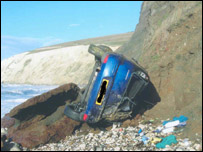
A 71-year-old man plunged off an 80ft cliff in a car and managed to walk away from the scene.

Coastguard officers, who winched the man back up the Isle of Wight cliff, said he may have driven over the edge when leaving a cliff-top car park.

The driver suffered head injuries when his Vauxhall Corsa hit the beach on Monday evening.

The cliff has been eroding in places and a police spokesman said the fall appeared to have been an accident. Police have said they believe the driver was heading towards Ventnor on Military Road and no-one else was involved in the accident.

The driver was taken to St Mary's Hospital, in Newport, where a police spokeswoman said he is being kept under observation for a few days. Brian Taylor, Solent Coastguard watch assistant, said: "He had an injury but managed to walk away from the car. It's an 80ft drop and it is a fairly steep drop so that's quite lucky for him to have survived. There's a car park and what usually happens is they think they are in reverse and they are actually in first gear and end up going forwards when they think they are going backwards."

The Blind World Cup

The Blind World Cup kicks off in Argentina tomorrow and the England squad have one vision – to bring home the trophy. Top scorer David Clarke, 36, born with glaucoma, reckons the team have a real shot at victory.

He said: “We don’t know who we’re playing yet but we want one of the big teams at the start. We’re as strong now as we have ever been. We’ve got a youthful side and we’ve been training hard.”

David, who plays up front and is a senior partner in a bank, added: “Ranking-wise we’re not top three but we’ve got the ability to win. It all depends on the draw. We’ve got either Brazil or Argentina in our group, which will be a big game. But after the group stages if we get France or someone then we’ve got a very good chance of going all the way.”

Just like the regular World Cup, the blind cup is every four years, with the Blind European Championships two years afterwards. And just like in the regular World Cup, two danger teams are Argentina and Spain.

Alex Stone, of the Football Association, says: “It was Spain that came up with the concept of blind football and they’re the world number one.Hosts Argentina are pretty good as well, so they’re the teams to beat. England are about fifth or sixth in the world so we stand a good chance.”

Making up the ten teams in action are Brazil, Paraguay, France, Japan, Korea, South Korea and Senegal. The England squad have been in Argentina getting used to the 25°C heat to be in top form for their opening game on Thursday.

When in the UK they train together once a month — but have been honing their bodies and skills every weekend for the past two months. The England team is funded by the FA and works to promote disability in sports.

Many players are all-round top performers. Alex Stone says: “One of our key players, Darren Harris, competes in judo and athletics to a high standard. And Keryn Seal plays for the blind England cricket squad. A lot of the lads in Argentina now are looking to compete in the Paralympics in Beijing in 2008.”

The Rules

  • The football is smaller than a normal ball. It is filled with ball bearings so players can hear it.
  • Games are five-a-side and teams can use five subs.
  • The crowd must be silent so players can hear where the ball is – but they can celebrate goals.
  • Players shout out when they want the ball passed to them.
  • A coach sits behind each goal and shouts so players know where to shoot.
  • All outfield players must be category B1 blind – completely blind – but still wear blindfolds. This follows a tournament where one player was partially sighted and kept scoring. The players are checked by an ophthalmologist at the start of every tournament.
  • Goalkeepers are sighted and not allowed out of their areas.
  • There are walls around the outside of the pitch so the ball is always in play.
  • Each half is 25 minutes.
  • There is no offside.

BA Cross fiasco

The Archbishop of York yesterday rapped British Airways after a Christian worker lost an appeal to openly wear her cross. Dr John Sentamu branded the ban “nonsense”.

He urged the airline to reconsider its policy. Check-in worker Nadia Eweida was told she could wear the symbol, but only when not in uniform and away from the public at Heathrow airport.

She refused and accused the firm of religious discrimination.

Yesterday she lost an internal appeal after BA insisted its policy was based on “practicality”. But Dr Sentamu said: “British Airways needs to look at the history of the country it represents, whose culture, laws, heritage and tradition owe so much to the symbol it would ban.”

Liberty campaigner Shami Chakrabarti said the appeal’s failure was a “bonkers result”.

And London Mayor Ken Livingstone said Nadia, 55, had a “right to wear a cross”. Nadia, of Twickenham, South-West London, is on unpaid leave but can return to work.

She wore the cross at yesterday’s meeting and insisted: “I’m not politically motivated, I just follow the Biblical truth.”

BA said she had a right to a second appeal next month.

Nightclub bans entire town

A nightclub has sparked anger after banning an entire town from entering.

Door staff at Creation in West Street, Brighton, told The Argus Crawley's "troublemakers" were no longer welcome.

Clubbers from the town, which has 35,000 18 to 40-year-olds, last night dismissed the ban as snobbery.
Head doorman Martyn Richardson said: "I only have one area ban and that's Crawley. We don't admit people from there. After we did it, the seafront clubs started telling me they were getting troublemakers from Crawley and we realised it was because we weren't letting them in here any more."

Creation has been turning away Crawley revellers for months by checking the ID of everybody who comes through the doors - and the head doorman said the policy was helping to drive down crime.

Mr Richardson, of Leisuresec, the country's largest supplier of security doormen, said a range of zero tolerance policies had reduced offences in the club by 73 per cent over 18 months.

A police officer from Operation Marble, which tackles booze-fuelled trouble in the notorious hot spots of West Street and the Lower Esplanade, told The Argus that crime had rocketed in Brighton in March when Brannigans nightclub in London Road, Crawley, closed for a month.

He said: "When the Crawley nightclub closed it took us a month to realise why crime had gone up."

The Sex Discrimination Act 1975 makes it unlawful for pubs and nightclubs that are open to the public to discriminate on the ground of sex when providing goods, facilities and services, even if they are free.

But the Equal Opportunities Commission said barring a town's entire population was unlikely to be against any discrimination law.

Flat-pack rage

More than 40 per cent of people who assemble flat-pack furniture lose their temper before finishing the job, a study revealed today.

The research, led by Dr Miles Richardson of Derby University, questioned 1,295 people who had attempted to build anything from shelving units to coffee tables.

The results showed that 67 per cent admitted getting into difficulty, 33 per cent misread or misunderstood the instructions and 13 per cent managed to damage the item before they finished constructing it.

Repeat song backfires on drunk thief

A man who stole diamonds worth more than a million dollars from a jewellers store in India has been arrested in a dance bar after he splurged to ensure the band play one song repeatedly.

Indian carpenter Divesh Borse decided to let his hair down in Mumbai after selling part of his haul, the Sunday Times newspaper says.

During two evenings at the bar, he spent hundreds of dollars as he requested the Bollywood song Humko Deewana Kar Gaye (He Made Me Crazy) by nasally balladeer Himesh Reshammiya be played over and over again.

But when a drunk Borse insisted on the song for a third straight evening others in the bar protested, the newspaper says.

To try and get his way he started showering 1,000 rupee notes on dancers, but had not counted on the presence of a police informer, who alerted his handlers.

Monday, November 20, 2006

Thief swallows evidence

A thief who decided to swallow his loot when apprehended by police was given away by a mysterious tummy ache.

The 30-year-old was spotted by off-duty police officers in the western German town of Bergish Gladbach apparently stealing something out of a store window.

But when the officers apprehended him, they found he was only carrying an empty box, according to a police spokesperson. Still, suspicions were raised when upon questioning, the man almost doubled over from pain.

"He said he'd grabbed the box and found it empty, but the shopkeeper said there was a ring missing," the spokesperson told Reuters. "Then during questioning he complained of severe stomach pains and was rushed to the hospital with suspected appendicitis."

Doctors x-rayed the patient in pain and discovered the ring in his stomach. It had to be fished out with a stomach tube that had small pincers on one end.

However, it appears that the ring had nothing directly to do with the severe abdominal distress, according to police. The reason for the sudden, and costly, tummy ache is not known.

Buenos Aires pillow fight

Lucha de almohadas. Buenos Aires pillow fight

Parque Tres de Febrero, in front of the Planetario building (Palermo), descended into pure feathery chaos, as Argentina’s 1st ever flash mob event took place - a ‘Lucha de Almohadas’. Basically, a massive outdoor pillow fight between a group of total strangers, arranged over the internet.

There must have been thousands there*, pillows in hand and ready for the fight, and possibly almost as many taking pictures and videos with their cameras.
Even the Argentinian Government posted about it on their blogsite :)

Red tape

Britain is being strangled by miles of "bizarre and petty" red tape that governs everything from the correct way for a farmer to tag a goat's ear to the dangers of falling conkers, a new book says.

Author Ross Clark believes excessive regulations frustrate businesses, waste time and drive people to break the law.

He paints a picture of a fearful society dominated by meddling officials working for a nanny state intent on wiping out all risk.

"It becomes increasingly difficult to stay within the law," Clark said. "If you have laws that are simple to understand, people are more likely to keep to them."

He has spent three years collecting the strangest examples of red tape for a new book, How to Label a Goat.

The title refers to a Welsh regulation: "The Sheep and Goats (Records, Identification and Movement) (Wales) Order 2006".

Over more than 40 pages, it tells farmers how to label their livestock with tattoos or eartags and how to transport them.

From complicated tax and pension law to health and safety rules, Clark details red tape he says "blights" people's lives:

# Soldiers learning the bagpipes have been banned from playing for more than 24 minutes a day to protect their ears.

# A Cardiff pensioner was stopped from getting on a bus because he was carrying a tin of paint, breaking health and safety rules. The bus company later apologised and said it would be more flexible.

# There are 279 different tax forms for businesses, asking more than 6000 questions.

# Landlords in Kent were ordered to pull down bundles of hops traditionally used to decorate their pubs. Fire inspectors said they were a hazard and should be treated with chemicals or replaced with plastic hops.

# A study by police in Tayside, eastern Scotland, found more than 1000 different forms available to officers. Of these, only 112 were regularly used and, on closer inspection, 30 were needed.

# New rules on child car seats are laid out over 18 pages, while bus lane regulations stretch to 27 pages.

# Bristol City Council spent £5000 ($NZ14,459) on 100 yew trees, only to dig them up after a "risk assessment" ruled they could harm children at a nearby playground if they ate the leaves.

# Norwich City Council ordered 20 roadside horse chestnut trees to be felled because falling conkers could damage cars, make the pavement slippery and lead to children being run over as they collected conkers. It later reportedly reversed the decision after facing worldwide ridicule.

A culture of "risk aversion" is fuelling the regulatory machine, Clark says. The growth of the public sector and service industry and the use of computers to handle paperwork have also played a part.

In the year to May, the government made 3600 pieces of law covering 98,000 pages – 70 times longer than War and Peace.

Clark says Britain should look to the Netherlands to ease the burden.

The Dutch have a "one in, one out" rule which says that for every new regulation, one must go.

Spot the idiots

China has banned TV ads for a freckle remover, touted as being so good it could remove spots from fish, when it not only killed fish but led to rashes, blisters and skin inflammation on the humans who tried it.

Advertisements promoting "Magic Freckle Removing Gel", produced by a Shanghai company, used a celebrity, bogus experts and fish to endorse the cosmetic, but fish exposed to the gel by a research institute later died from poisoning, the Beijing News said.

"(The institute) carried out a test washing the fish's spots in the gel. Two fish died successively on the third and sixth days," the paper said, citing an investigative report on Chinese state television.

Experts later found that three different fish had been used in the advertisement to make the cleanser appear effective, the paper said.

Claims that the cleanser was produced by an American company using "American technology" were also found to be false.

The gel used a plant-based compound often used in traditional Chinese medicine to reduce fever and phlegm, but its claim that it had spot-removing properties was "unscientific", the paper said.

"Not only can it not remove spots, it also has a certain amount of poison," the paper said.

Consumers in Shanghai, Beijing and several Chinese provinces had complained of "rashes, skin inflammation, blistering, coloured spots and other adverse reactions", after using the product, the paper said.

China's trade watchdog, the State Administration of Commerce and Industry, had banned the ad and ordered provincial offices to investigate, the paper said.

The advertisements were no longer on television, but internet sales were still available, the paper said.

China is attempting to crack down on false and misleading advertising amid rising consumer fury stemming from a spate of recent health scares, but loose administration and approval procedures have resulted in a number of bogus and unsafe products going to market.

Tightwad bank to close

KANSAS CITY, Mo. (AP) - A small-town bank that drew $2.2 million in deposits from around the country because of its unusual name will close Jan. 31.

The Tightwad Bank opened on a shoestring 22 years ago in the small community along Missouri 7 halfway between Clinton and Warsaw.

Now, UMB Bank Warsaw, which operates the bank, is cutting costs and has urged customers to do their banking at its branches in Clinton and Warsaw.

Officials at UMB, a subsidiary of UMB Financial Corp (UMBF), would not elaborate on the decision.

"I don't like it at all," said Tightwad resident Linda Houk. "I'm not sure I'll leave my accounts at UMB."

Two months after the Tightwad Bank opened in May 1984, an article on it appeared in The Kansas City Times. Word began to spread.

"We were discovered," said Gene Henry, a Clinton banker who helped open the Tightwad Bank. "People would just mail us a check, Tightwad Bank, Tightwad, Missouri, sometimes with no ZIP code, and the post office, to its credit, found us."

Up to a dozen checks would arrive daily, each with a note asking for an account and a batch of Tightwad Bank checks, Henry said. In two years, customers from near and far gave the bank $2.2 million in deposits.

The bank started as a branch of a Windsor bank whose chairman foresaw growth fueled by development around the then-new Truman Lake. Henry said some even envisioned Tightwad as becoming the next Branson.

But growth never came. Tightwad, population 63, has eight more residents now than when the bank opened.